Loading...

ONE DOCUMENT, BORDERLESS TRADE: HOW GHANA IS TRANSFORMING WORLD COMMERCE

13 Jul, 2026 General

From the misty hills of Chongqing to the bustling port of Tema, a quiet revolution in global trade is taking shape. It began with a two-day conference in southwestern China and will culminate this October in Accra with the signing of a treaty that could redefine how goods move across borders for the next century.

This is the story of the UN Convention on Negotiable Cargo Documents, soon to be known worldwide as “The Accra Convention”.

The Mountain City Meeting

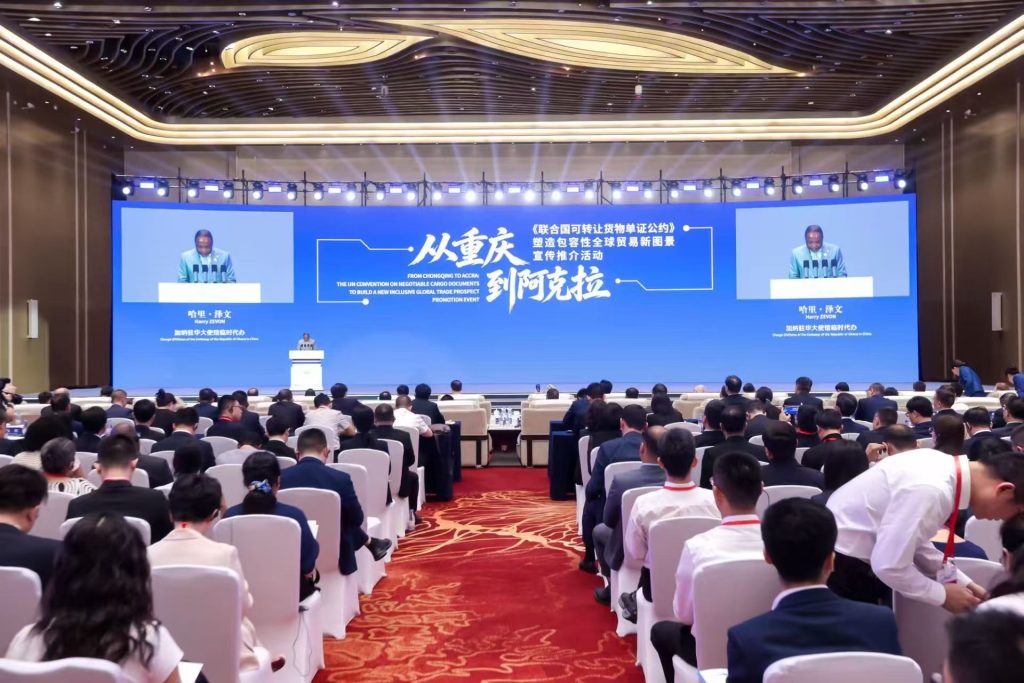
From 31st May to 1st June 2026, Chongqing Municipality hosted a landmark promotional conference titled “From Chongqing to Accra”. The name itself tells the story; a journey from China’s inland logistics hub to Ghana’s capital, where history will be made.

Organised jointly by the Chongqing Municipal Government, China’s Ministry of Commerce, and the UN Commission on International Trade Law Secretariat (UNCITRAL), the conference brought together trade officials, legal experts, shippers, financiers, and diplomats. Their mission is to build momentum for the UN Convention on Negotiable Cargo Documents (UNCNCD), adopted by the United Nations General Assembly in Resolution A/RES/80/182 on 15 December 2025.

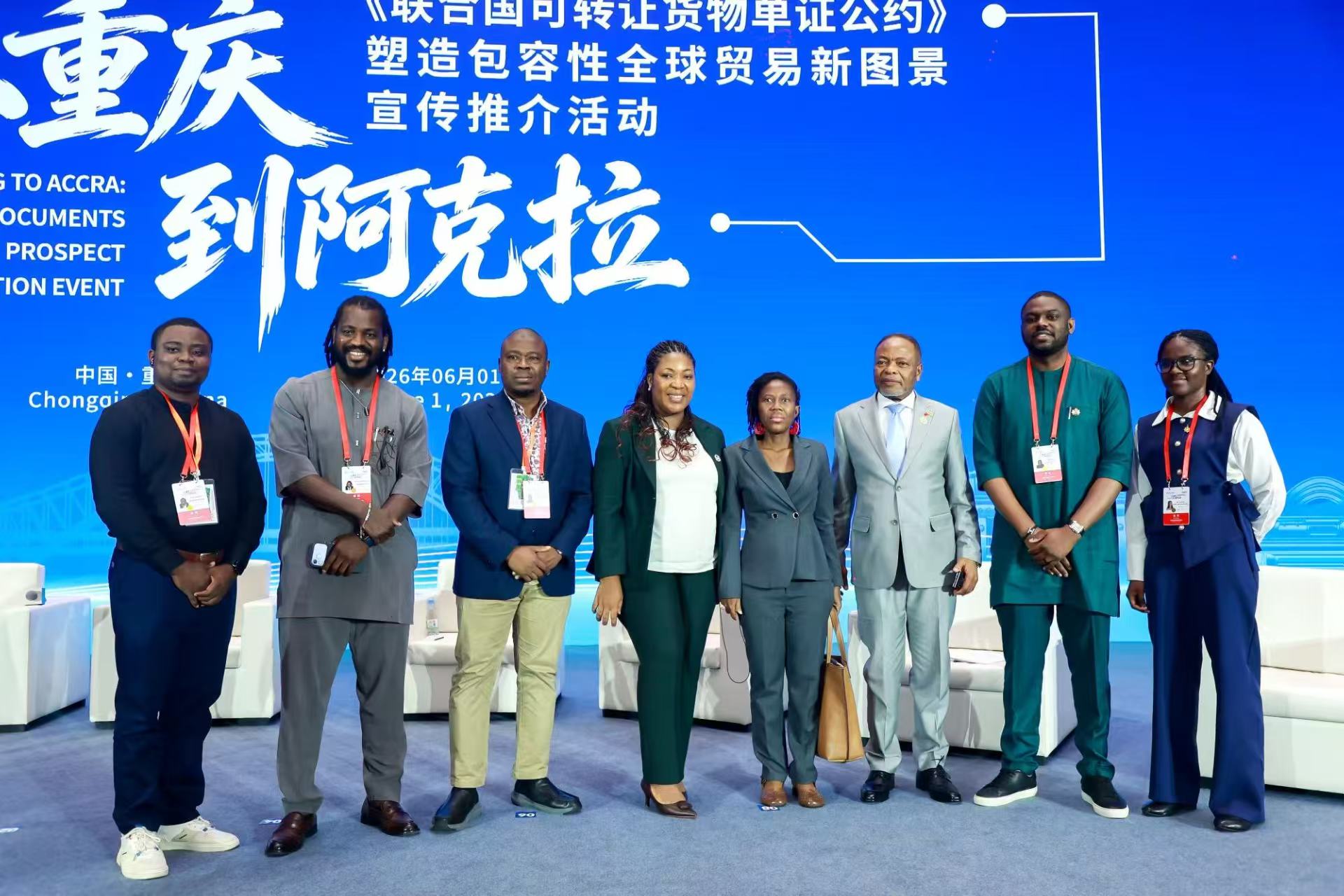
Representing Ghana was a strong delegation from the Embassy in Beijing, Dr. Harry Zevon, Deputy Head of Mission, attended in place of His Excellency Kojo Bonsu, Ambassador of Ghana to the People’s Republic of China, and delivered an address on the Ambassador’s behalf. He was accompanied by Ms. Ruby Saakor, Minister Counsellor for Trade. Joining them were Mrs. Rhodalyn Djanitey and Ms. Lordina Ashong from the Ghana Shippers’ Authority; the technical experts ensuring Ghana’s voice reflects the realities of exporters and importers on the ground.

For Dr. Zevon, the Chongqing meeting was more than a technical workshop. He told delegates that, they came from Ghana to Chongqing not just to observe, but to connect the dots. He said Chongqing to Accra is not just a route on a map, it is a route from idea to implementation, from negotiation to ratification, and from promise to practice.

Significance of a New Convention

To understand the significance of Accra, you must first understand the problem it solves. Today, about 90% of world trade moves by sea, but the “door-to-door” journey rarely ends at the port. A container of shea butter from northern Ghana may travel by truck to Tema, by ship to Shanghai, by rail to Chongqing, and finally by truck to a factory inland. Each mode of transport has its own document, a road consignment note, a bill of lading for sea, an air waybill, or a rail note.

Only the ocean bill of lading is a “negotiable” document, meaning it represents ownership of the cargo itself. Banks accept it as collateral. Traders can sell it while the ship is still at sea. The other documents are not. This legal gap creates friction, cost, and risk.

Mrs. Rhodalyn Djanitey of the Ghana Shippers’ Authority explains that if cargo switches from ship to rail in Chongqing, you often have to issue a whole new set of papers, dfferent templates, different data fields, different legal rules on who owns what. In a world of delays, wars, and sudden market shifts, that paperwork can cost one the deal.

For Small and Medium Enterprises in Ghana and across Africa, the impact is severe. Without a negotiable document, their goods in transit cannot be used as collateral for trade finance. When COVID-19, the Red Sea disruptions, or severe weather reroute ships, the lack of a unified document slows every response.
A Six-Year Journey

The seed of the solution was planted in 2019, when the People’s Republic of China presented a proposal to UNCITRAL. China, with its vast multimodal networks linking the Yangtze River, high-speed rail, and ports like Chongqing, had experienced the pain firsthand. The proposal was simple in concept, complex in execution; create one legal framework for one document, paper or electronic, that works for sea, road, rail, and air.

What followed were years of careful, inclusive negotiations under UNCITRAL. Delegates from over 80 countries debated definitions, ownership rights, electronic signatures, and blockchain security. On 15 December 2025, the UN General Assembly adopted the Convention.

And then came the diplomatic coup; Ghana won the naming rights. When ratified in Accra on 26 October 2026, the UNCNCD will become “The Accra Convention”.

It will be the first time in many decades that a treaty of such global economic significance is signed on African soil. For Ghana, it is both an honour and a responsibility.

Dr. Zevon said in Chongqing said Ghana is extremely proud to host this event but pride must translate into purpose. The Accra Convention is not just Ghana’s convention; it is Africa’s convention. It is the convention for every developing country whose exporters have been left behind by outdated paperwork.

One Document Borderless Trade

In plain language, the Accra Convention creates a single, legally recognised cargo document that works across all transport modes. Think of it as a “passport for goods”. Once in force, signatory countries will see four immediate transformations:

1. Goods in transit become liquid assets 

A cocoa shipment traveling from Kumasi to Rotterdam can be sold, bought, or pledged as collateral while it is still on the high seas or on a train in Europe. For Ghana’s SMEs, this opens access to trade finance that was previously locked until delivery. Banks can lend against the document with confidence.

2. Supply chains become resilient

When the Suez Canal was blocked in 2021, rerouting cargo meant weeks of new paperwork. Under the Accra Convention, you can switch a shipment from sea to rail to road without issuing new documents. The single document travels with the cargo, updating digitally as modes change. Disruptions caused by market forces, war, or severe weather can be managed in real time.

3. Complexity and costs drop 

Exporters currently spend time and money preparing three to four 4 different documents for one journey. The Convention replaces them with one document covering “door-to-door” multimodal transport. Customs clearance speeds up because data is standardised. Transaction costs fall.

4. Trade goes fully digital and secure 

The Convention fully supports electronic negotiable documents. Document management and security will be done via block chain technology. This means tamper-proof records, instant verification, and no risk of lost or forged paper bills. For Ghana, this aligns directly with the government’s digitalisation agenda for ports and customs.

Ms. Ruby Saakor, the Embassy’s trade expert said the Accra Convention is a legal framework that will make global trade work better, fairer, and faster and developing countries stand to benefit the most.

5. Why Accra?

Naming a treaty is more than symbolism. It anchors the treaty in a place, a people, and a purpose.

Ghana was chosen for three reasons. First, as a trading nation with a major port in Tema and a growing logistics corridor through the Sahel, Ghana understands the multimodal challenge. Second, Ghana has consistently championed African unity and global South interests in trade negotiations. Third, Accra offers political stability and diplomatic convening power.

Hosting the ratification ceremony on 26 October 2026 positions Accra as the birthplace of 21st-century trade law. Ghana is now reaching out to members of the African Union, Commonwealth nations, and Small Island Developing States to solicit their support and attendance. The goal is not just signatures, but a coalition of countries ready to implement.

6. From Proposer to Partner

No story of the Accra Convention is complete without acknowledging China’s role. From the 2019 proposal to co-hosting the Chongqing conference, China has been the Convention’s earliest and strongest advocate.

Dr Zevon emphased that, Ghana is very grateful to the People’s Republic of China for its continuing support; together both countries are building the legal bridge from Chongqing’s rail hubs to Accra’s ports, and from there to the world.

For China, the Convention supports the New International Land-Sea Trade Corridor and Belt and Road connectivity. For Ghana, it opens new pathways for exports to Asia via multimodal routes. The Chongqing-to-Accra axis is becoming a metaphor for South-South cooperation that delivers concrete results.

7. The Road Ahead

The Chongqing conference was the midpoint, not the finish line. The next five months will be intense.

Ghana’s Ministry of Foreign Affairs, Ministry of Trade, and Attorney General’s Department are preparing domestic legal reforms to align with the Convention. The Ghana Shippers’ Authority will lead stakeholder engagement with shippers, banks, and insurers. The Embassy in Beijing will continue working with Chinese partners to encourage early adoption.

On 26 October 2026, Heads of State, Trade Ministers, and UNCITRAL officials will gather in Accra. With each signature, the Convention moves closer to entry into force. Once enough countries ratify, the world’s cargo documents will change forever.

For Ghanaian exporters of pineapples, gold jewelry, textiles, and processed foods, this means fewer delays, cheaper finance, and more competitive access to global markets. For the world, it means supply chains that are less brittle and more inclusive.

8. A Convention for the Future

In the lobby of the Chongqing conference center, a large screen showed a live map; cargo containers moving from the Port of Tema, across the Atlantic, through the Mediterranean, onto rail in Chongqing, and into factories in Sichuan.

Dr. Zevon informed delegates that, for decades, trade documents have lagged behind trade realities and the Accra Convention closes that gap. In 2026, cargo now does not care if it is on a ship, a train, or a truck. It just needs to move. The law should move with it.

From Chongqing to Accra is 12,000 kilometers by air. But in trade law terms, it is the shortest distance between an old problem and a new solution.

As the countdown to 26 October 2026 continues, Ghana invites the world to join this journey. The Accra Convention is not just about documents. It is about dignity for traders, resilience for supply chains, and fairness for developing nations.

And it all began with a conversation in Chongqing.

Compiled by: Moses Sackie, Counsellor/Information, Embassy of Ghana, People’s Republic of China.
From the misty hills of Chongqing to the bustling port of Tema, a quiet revolution in global trade is taking shape. It began with a two-day conference in southwestern China and will culminate this October in Accra with the signing of a treaty that could redefine how goods move across borders for the next century.

This is the story of the UN Convention on Negotiable Cargo Documents, soon to be known worldwide as “The Accra Convention”.

The Mountain City Meeting

From 31st May to 1st June 2026, Chongqing Municipality hosted a landmark promotional conference titled “From Chongqing to Accra”. The name itself tells the story; a journey from China’s inland logistics hub to Ghana’s capital, where history will be made.

Organised jointly by the Chongqing Municipal Government, China’s Ministry of Commerce, and the UN Commission on International Trade Law Secretariat (UNCITRAL), the conference brought together trade officials, legal experts, shippers, financiers, and diplomats. Their mission is to build momentum for the UN Convention on Negotiable Cargo Documents (UNCNCD), adopted by the United Nations General Assembly in Resolution A/RES/80/182 on 15 December 2025.

Representing Ghana was a strong delegation from the Embassy in Beijing, Dr. Harry Zevon, Deputy Head of Mission, attended in place of His Excellency Kojo Bonsu, Ambassador of Ghana to the People’s Republic of China, and delivered an address on the Ambassador’s behalf. He was accompanied by Ms. Ruby Saakor, Minister Counsellor for Trade. Joining them were Mrs. Rhodalyn Djanitey and Ms. Lordina Ashong from the Ghana Shippers’ Authority; the technical experts ensuring Ghana’s voice reflects the realities of exporters and importers on the ground.

For Dr. Zevon, the Chongqing meeting was more than a technical workshop. He told delegates that, they came from Ghana to Chongqing not just to observe, but to connect the dots. He said Chongqing to Accra is not just a route on a map, it is a route from idea to implementation, from negotiation to ratification, and from promise to practice.

Significance of a New Convention

To understand the significance of Accra, you must first understand the problem it solves. Today, about 90% of world trade moves by sea, but the “door-to-door” journey rarely ends at the port. A container of shea butter from northern Ghana may travel by truck to Tema, by ship to Shanghai, by rail to Chongqing, and finally by truck to a factory inland. Each mode of transport has its own document, a road consignment note, a bill of lading for sea, an air waybill, or a rail note.

Only the ocean bill of lading is a “negotiable” document, meaning it represents ownership of the cargo itself. Banks accept it as collateral. Traders can sell it while the ship is still at sea. The other documents are not. This legal gap creates friction, cost, and risk.

Mrs. Rhodalyn Djanitey of the Ghana Shippers’ Authority explains that if cargo switches from ship to rail in Chongqing, you often have to issue a whole new set of papers, dfferent templates, different data fields, different legal rules on who owns what. In a world of delays, wars, and sudden market shifts, that paperwork can cost one the deal.

For Small and Medium Enterprises in Ghana and across Africa, the impact is severe. Without a negotiable document, their goods in transit cannot be used as collateral for trade finance. When COVID-19, the Red Sea disruptions, or severe weather reroute ships, the lack of a unified document slows every response.

A Six-Year Journey

The seed of the solution was planted in 2019, when the People’s Republic of China presented a proposal to UNCITRAL. China, with its vast multimodal networks linking the Yangtze River, high-speed rail, and ports like Chongqing, had experienced the pain firsthand. The proposal was simple in concept, complex in execution; create one legal framework for one document, paper or electronic, that works for sea, road, rail, and air.

What followed were years of careful, inclusive negotiations under UNCITRAL. Delegates from over 80 countries debated definitions, ownership rights, electronic signatures, and blockchain security. On 15 December 2025, the UN General Assembly adopted the Convention.

And then came the diplomatic coup; Ghana won the naming rights. When ratified in Accra on 26 October 2026, the UNCNCD will become “The Accra Convention”.

It will be the first time in many decades that a treaty of such global economic significance is signed on African soil. For Ghana, it is both an honour and a responsibility.

Dr. Zevon said in Chongqing said Ghana is extremely proud to host this event but pride must translate into purpose. The Accra Convention is not just Ghana’s convention; it is Africa’s convention. It is the convention for every developing country whose exporters have been left behind by outdated paperwork.

One Document Borderless Trade

In plain language, the Accra Convention creates a single, legally recognised cargo document that works across all transport modes. Think of it as a “passport for goods”. Once in force, signatory countries will see four immediate transformations:

1. Goods in transit become liquid assets 

A cocoa shipment traveling from Kumasi to Rotterdam can be sold, bought, or pledged as collateral while it is still on the high seas or on a train in Europe. For Ghana’s SMEs, this opens access to trade finance that was previously locked until delivery. Banks can lend against the document with confidence.

2. Supply chains become resilient

When the Suez Canal was blocked in 2021, rerouting cargo meant weeks of new paperwork. Under the Accra Convention, you can switch a shipment from sea to rail to road without issuing new documents. The single document travels with the cargo, updating digitally as modes change. Disruptions caused by market forces, war, or severe weather can be managed in real time.

3. Complexity and costs drop 

Exporters currently spend time and money preparing three to four 4 different documents for one journey. The Convention replaces them with one document covering “door-to-door” multimodal transport. Customs clearance speeds up because data is standardised. Transaction costs fall.

4. Trade goes fully digital and secure 

The Convention fully supports electronic negotiable documents. Document management and security will be done via block chain technology. This means tamper-proof records, instant verification, and no risk of lost or forged paper bills. For Ghana, this aligns directly with the government’s digitalisation agenda for ports and customs.

Ms. Ruby Saakor, the Embassy’s trade expert said the Accra Convention is a legal framework that will make global trade work better, fairer, and faster and developing countries stand to benefit the most.

5. Why Accra?

Naming a treaty is more than symbolism. It anchors the treaty in a place, a people, and a purpose.

Ghana was chosen for three reasons. First, as a trading nation with a major port in Tema and a growing logistics corridor through the Sahel, Ghana understands the multimodal challenge. Second, Ghana has consistently championed African unity and global South interests in trade negotiations. Third, Accra offers political stability and diplomatic convening power.

Hosting the ratification ceremony on 26 October 2026 positions Accra as the birthplace of 21st-century trade law. Ghana is now reaching out to members of the African Union, Commonwealth nations, and Small Island Developing States to solicit their support and attendance. The goal is not just signatures, but a coalition of countries ready to implement.

6. From Proposer to Partner

No story of the Accra Convention is complete without acknowledging China’s role. From the 2019 proposal to co-hosting the Chongqing conference, China has been the Convention’s earliest and strongest advocate.

Dr Zevon emphased that, Ghana is very grateful to the People’s Republic of China for its continuing support; together both countries are building the legal bridge from Chongqing’s rail hubs to Accra’s ports, and from there to the world.

For China, the Convention supports the New International Land-Sea Trade Corridor and Belt and Road connectivity. For Ghana, it opens new pathways for exports to Asia via multimodal routes. The Chongqing-to-Accra axis is becoming a metaphor for South-South cooperation that delivers concrete results.

7. The Road Ahead

The Chongqing conference was the midpoint, not the finish line. The next five months will be intense.

Ghana’s Ministry of Foreign Affairs, Ministry of Trade, and Attorney General’s Department are preparing domestic legal reforms to align with the Convention. The Ghana Shippers’ Authority will lead stakeholder engagement with shippers, banks, and insurers. The Embassy in Beijing will continue working with Chinese partners to encourage early adoption.

On 26 October 2026, Heads of State, Trade Ministers, and UNCITRAL officials will gather in Accra. With each signature, the Convention moves closer to entry into force. Once enough countries ratify, the world’s cargo documents will change forever.

For Ghanaian exporters of pineapples, gold jewelry, textiles, and processed foods, this means fewer delays, cheaper finance, and more competitive access to global markets. For the world, it means supply chains that are less brittle and more inclusive.

8. A Convention for the Future

In the lobby of the Chongqing conference center, a large screen showed a live map; cargo containers moving from the Port of Tema, across the Atlantic, through the Mediterranean, onto rail in Chongqing, and into factories in Sichuan.

Dr. Zevon informed delegates that, for decades, trade documents have lagged behind trade realities and the Accra Convention closes that gap. In 2026, cargo now does not care if it is on a ship, a train, or a truck. It just needs to move. The law should move with it.

From Chongqing to Accra is 12,000 kilometers by air. But in trade law terms, it is the shortest distance between an old problem and a new solution.

As the countdown to 26 October 2026 continues, Ghana invites the world to join this journey. The Accra Convention is not just about documents. It is about dignity for traders, resilience for supply chains, and fairness for developing nations.

And it all began with a conversation in Chongqing.

Compiled by: Moses Sackie, Counsellor/Information, Embassy of Ghana, People’s Republic of China.
Translate »
x